
By. Quincy M. Simmons
Story Overview
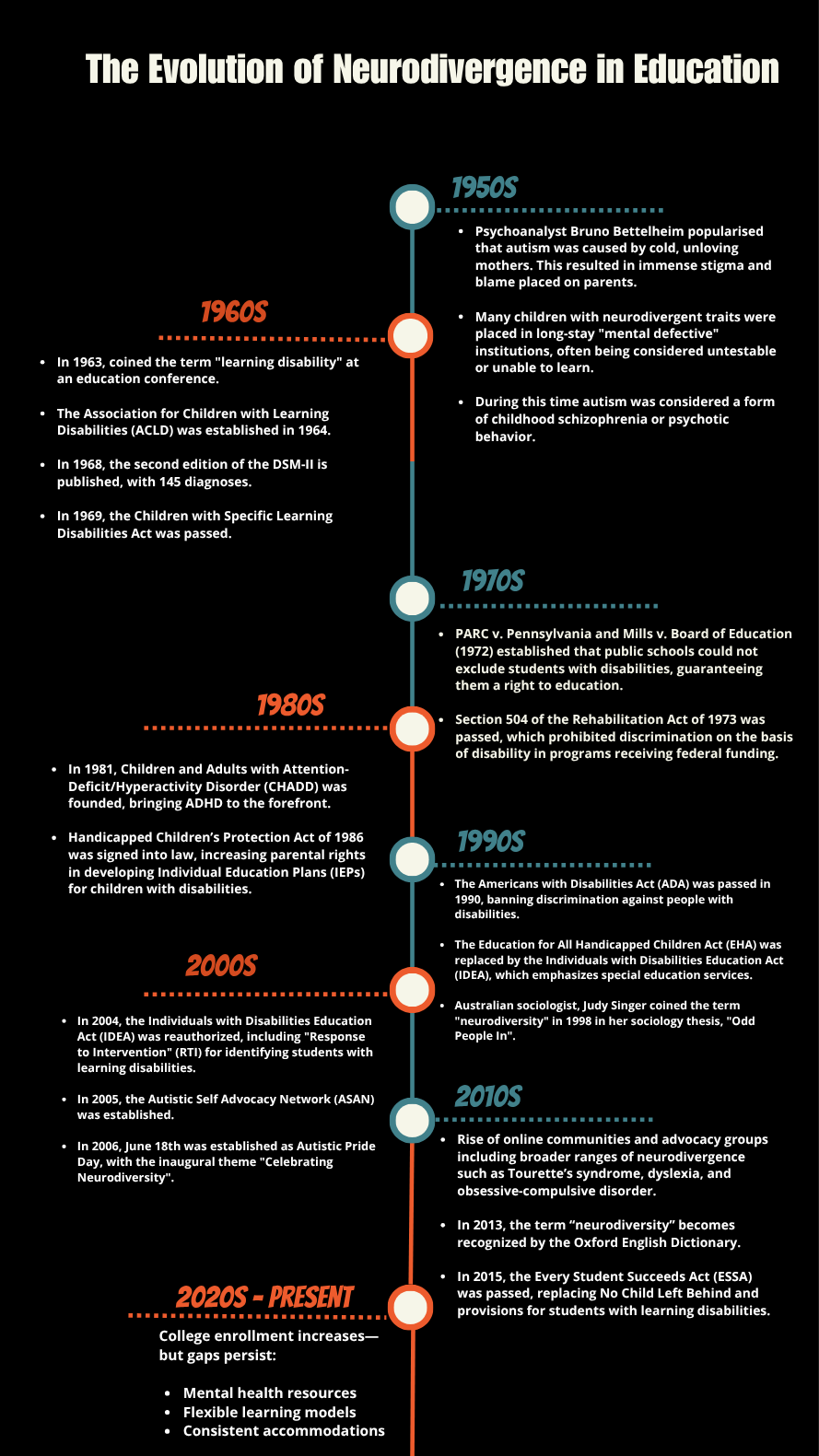
Not long ago, neurodivergent students were pushed away from higher education—mischaracterized as incapable, denied proper support or steered toward alternative paths.
When Brian Liston, who self-identifies as being on the autism spectrum, started attending Ulster Community College in 1999, he had little support. “The transition from high school to college “was a jump from structure to free fall,” he said. College broke his safety net—forcing him to advocate for himself and accommodations. In high school, Liston benefited from structured support, with faculty providing consistent guidance and assistance. In college, that support shifted—he was expected to independently manage his time, meet deadlines, and navigate a more complex schedule.
He realized the higher education system wasn’t built around neurodivergent folks like himself.
College has always been a challenge for anyone wishing to pursue higher education—but the story of who gets to be there is beginning to change.
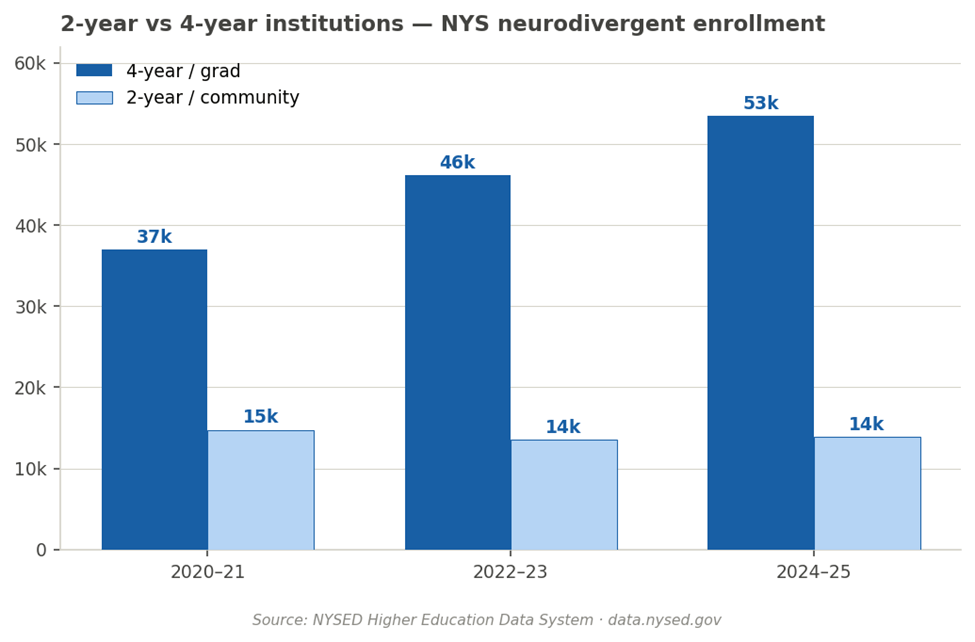
Within the past five years, there’s been a 30.1% growth of neurodivergent students enrolling in higher education institutions in New York, according to the New York State Education Department. Neurodivergence is a term encompassing various neurodevelopmental and learning disabilities such as autism, ADHD, dyslexia, dyscalculia, OCD and Tourette’s syndrome.
The question is, why now?
“As a result of the reduced stigma and availability of support, individuals who are neurodivergent are recognizing college as an option whereas it wasn’t in years past,” said Emi DiSciullo, assistant director for neurodiversity initiatives at SUNY New Paltz’s Disability Resource Center (DRC). During the 2024-25 academic year, 728 neurodivergent students registered with the DRC.
Jordan Corvin, who identifies as having high-functioning autism, chose to pursue higher education to shelter him from the rigors of adulthood. “The mindset of a degree is something good to have in your back pocket,” said Corvin, a 2023 SUNY Delhi graduate.
Initially, he graduated from Delhi with an associate’s in electrical construction. From there, he was given a choice: go into the workforce or continue his path in higher education.
His undergraduate experience was chaotic in terms of loud noises in his residence hall, fostering social interactions, and advocating for himself. “Being away from home caused me immense stress and pressure. I didn’t have the direct support I once had,” he said.
Despite these hardships, Corvin earned his bachelor’s in construction management. Now, he’s a heavy equipment operator. While he credits college for shaping who he is today, he believes higher education should foster more open conversations around accommodations and better prepare students of the shift from high school to the independence of college.
Outdated Classrooms, Modern Minds
Many colleges have followed Universal Design for Learning, which addresses the wide variation in learners—including learners who are neurodivergent or from different cultural backgrounds. UDL provides multiple formats that benefit all students. It shifts from fixing a problem to removing barriers in the curriculum itself.
“As a neurodivergent student, I’ve found that recorded lectures, clear structure in assignments, and professors explaining expectations step-by-step help me stay organized and engaged,” said Faris Amin, a freshmen accounting student at Fordham University.
All these multi-modes are part of the Universal Design for Learning, which has been encouraged by advocates for faculty to integrate into their learning models.
As an accounting major, Faris finds these multi-modes of UDL helpful in interacting with complex financial concepts and strengthening cognitive function. “Combining lectures with visuals, discussions, or hands-on activities can make material more accessible,” he said.
However, UDL has been criticized for overlooking sensory and specific needs.
“College is an overwhelming sensory environment,” said Jane Thierfeld Brown, former director and founder of the College Autism Spectrum. “Places like the residence halls, dining halls, and fitness center can be stressful for neurodivergent students to maneuver through.”
UDL’s “one-size-fits all” approach doesn’t replace the need for individualized accommodations; it falls short in addressing sensory needs many neurodivergent students navigate. While UDL expands access, it may not fully account for how sensory input—noise, pacing, or stimulation—can impact a student’s abilities to learn and engage. Neurodivergent students seek environments that reduce sensory overload and provide more tailored support to their needs.
Accommodations or Obstacles?
Quoting disability advocate Keshi Iman Wilson, Emily Doffing of the Disability Research Education and Mentoring Program said, “Accommodations are the floor, not the ceiling.” Funded by the National Center for College Students with Disabilities, DREAM serves as an online virtual disability cultural center for students to connect with other students and professionals.
Dr Michelle Meyer, a professor in SUNY New Paltz’s psychology department, notes “there are the systemic acknowledgments of neurodivergence, and that’s where you get the DRC and classroom accommodations,” she said, “beyond those usually federal or state mandated requirements, most faculty don’t get training around handling neurodivergence.”
“There’s just a lot of creative ways to expand accommodations the way it’s physically done now,” Doffing said. Doffing urges more training for professors to integrate alternative grading or alternative assignments that “gives students more autonomy on how they want to learn,” she said.
As the need for accommodations grows, the funding for it is endangered. Cuts in the National Institute of Health (NIH) funding to State University of New York (SUNY) system totaled $79 million in 2025. This funding covered access to assistive technology, support staff, and vocational rehabilitation services—services critical for students with disabilities navigating their higher education.
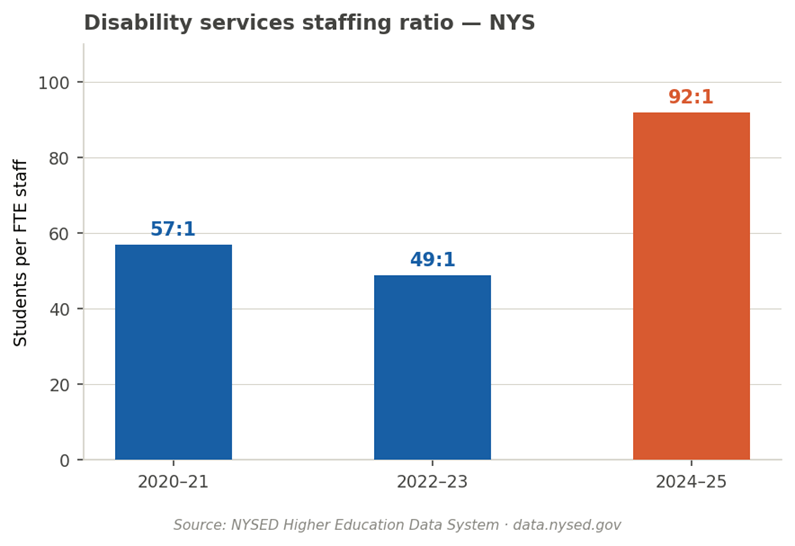
The 2025-26 New York State budget included $10 million to expand services for SUNY students with disabilities—not nearly enough to fill the void.
“It takes resources and people power to get these things to be done,” said Meyer.
Mental Health Support
“Part of neurodivergence comes with social and emotional expectations. These are important skills for them to foster during adulthood,” said Kenneth Mims, founder of the Neurodiversity Education Research Center (NERC). Higher education should prioritize more mental health “The first thing services and staff training catered towards neurodivergence. first thing that we can do is training and having representation within that training.
Dawn Danner, director of the Uniquely Abled Academy at Hudson Valley Community College, created an optional workshop to HVCC faculty in March 2026. The Uniquely Abled Academy is devoted to empowering individuals on the spectrum through vocational and technical opportunities. This program is the only one in New York state and one of the 33 in the nation.
In her workshop, “Setting the Stage for Neurodivergent Success,” she discusses neurodivergent masking, an act of suppressing neurodivergent traits to appear neurotypical. “They mask their disability, they mask their natural tendencies to stim or to move or to fidget, whatever it might be, because they feel like they will be judged,” she said.
Recently, Danner met with a student who was falling behind in his classes. During the conversation with the student, he confided in Danner that he was experiencing personal problems with an ex-girlfriend that caused him immense stress and anxiety. She gave him some tips on how to cope with his mental health.
While she acknowledged this type of support wouldn’t likely happen in a typical classroom, students wouldn’t feel the need to mask. Masking reduces student’s learning capacity, focus and academic performance.
“Prolonged masking can kind of force someone into losing pieces of their identity, because then it becomes, like, who am I? Who is my authentic self?” said Amy Rutherford, director of the College Autism Spectrum.
Rutheford, who was diagnosed with ADHD and dyslexia in fourth grade, understands firsthand the impact of masking on one’s psychological safety. “Psychological safety is having a space to process through information; being able and safe to make mistakes,” she said, “or having folks help support you as you navigate,” she said.
Masking as a healthy coping mechanism for neurodivergence is a myth. It instead forces neurodivergent people to hide their traits to be accepted out of society, leading to burnout and further mental health struggles.
The Role of Educators in Student Success
A student realized they were falling behind in Cornell University instructor Florencia Ardon’s course. Living with an auditory processing disorder meant that even Ardon’s lecture—which includes subtitles and moves at a steady pace, felt overwhelming.
When the student reached out to her, it wasn’t to request an extension on an assignment—it was to drop the class because it felt inaccessible.
Ardon took this feedback in stride. “I spoke to the student and told them, you can come to class, we can have as many sessions before or after class as needed…additionally if there are any assignments that you don’t feel prepared to submit, just tell me and we can excuse them,” she said.
That conversation changed everything. The student stayed, completed the course, and earned an A.
The structure of how higher education is set up can be a barrier. This was in fact one of the goals of Danner’s “Setting the Stage for Neurodivergent Success” at HVCC: discussing how faculty/staff can be solutions in current learning expectations and practices for neurodiverse populations.
During the workshop, Danner bought Play-Doh and fidget toys and encouraged faculty to use them. “I was like, I want you to be comfortable. Nobody likes listening to lectures, it’s not always fun,” she said. Things like this wouldn’t require any funding, but it helps make classrooms more inclusive and underwhelming. “You have the person with autism who’s going to really appreciate that fidget toy, but a neurotypical student probably will as well,” she said.
However, there was a low attendance at her event. She hoped for a bigger turnout as faculty and staff are responsible for setting the climate and precedent of the classroom.
At the UAA, she’s able to provide more individualized support and attention. Danner met 1:1 with a student who was applying for a job, seeking assistance with their resume. Although she had done several group lessons with the class on resumes, “we worked through it together and he was proud to have a completed resume in a short time,” she said.
Solutions
Institutions like SUNY New Paltz are ensuring neurodivergent students are validated and supported in and out of the classroom. “Supporting Diverse Learners” is a new training launched by New Paltz’s DRC in attempt to narrow the gap between neurodivergent students and faculty. This training provides “information and strategies to promote an inclusive learning experience for all students.” Di Sciullo hopes this will change how neurodivergence is understood and how it impacts the student experience.
“I feel like a lot of people with disabilities struggle with learning books vs hands-on/visually…it’s all about what our strengths are,” said Corvin. In high school, Corvin enrolled in the BOCES program, an organization specializing in career and technical education (CTE). Being enrolled in BOCES helped him realize he was a hands-on learner. He enjoyed working with machinery and tools which inspired his pursuit of electrical construction/construction management in college.
Brown believes students can explore things they enjoy through hands-on learning. While she appreciates values internship opportunities, she argues practical experience should begin earlier. “Wouldn’t it be great,” she said, “if before you were shipped off to an internship, you were doing more hands-on learning in your education rather than just studying it?”
Neurodivergent & Proud
Since graduating in 2009, Brian Liston has become a poet, writer, and researcher. He uses these skills in his work with disability advocacy groups such as The Arc Mid-Hudson and GRASP.
He hopes that higher education will see more than just a student’s diagnosis. “It’s one thing to read an IEP or something a person feels they can do, but another thing to understand that person as an individual,” he said.
While Liston has made the most out of his undergraduate experience, current students are still navigating systems that prioritize labels over lived experience.The tension between progress and persistence continues to shape the experience of current neurodivergent students like Faris Amin.
By zoning in on the voices of neurodivergent students, higher education can become “an environment where learning differences are accepted and supported,” Amin said, “to make a big impact not just for neurodivergent students but everyone.”
 Quincy M. Simmons
Leave a comment